Florida Wildflowers
Reds and Oranges
Native wildflowers are far more than scenery. They are the foundation of Florida's ecological web, providing nectar, pollen, and larval host plants for butterflies, bees, hummingbirds, and countless other pollinators. Species such as Scarlet Milkweed sustain Monarch butterflies, while Blanket Flower and Tropical Sage draw a steady parade of visitors to roadsides and gardens alike. Learning to recognize these wildflowers — by their habitat, leaves, and bloom — is the first step toward appreciating, protecting, and even cultivating the wild beauty that makes Florida's natural areas so distinct.
Florida is home to more than 3,200 species of native plants of these 400-500 are specifically designated as wilflowers. A remarkable diversity born of the state's unique mosaic of habitats — pine flatwoods, sandhills, scrub, wet prairies, freshwater marshes, hammocks, and coastal dunes. From the fiery reds of Tropical Sage and the cheerful yellows of the state wildflower - Tickseed, to the delicate pinks of Marsh Pink and the deep purples of Florida Paintbrush these plants paint the landscape across every season. Many bloom year-round in the subtropical south, while others put on spectacular spring and fall displays farther north, offering something new for observers in every month of the year.
Blanket Flower - Gaillardia pulchella
Family - Asteraceae

Habitat - Dry Prairies & Flatwoods
Description - Florida native plant, annual or perennial. Subshrub 12 to 24 inches, clump forming, usually wider than tall.
Hairy, velvety textured stems with alternate oblanceolate to spatulate leaves having serrate margins, 4-8 inches long.
Variable yellow, orange and red flowers, 2-3 inches across in summer and fall. Easily grown from seed, Gaillardia is available in several varieties. Drought tolerant once established, requires well drained soil & flowers best in full sun. Self seeding & clump forming. Allow the seed heads to dry thoroughly before collecting. Flowers are attractive to butterflies.
Tropical Sage - Salvia coccinea
Family - Lamiaceae (Mint Family)
.jpg)
Habitat - Hammocks on calcareous soils, Shell mounds
Description - Native annual or perennial herb to 3 feet. Leaves ovate to cordate, margin crenate. Stems square, hairy. Can be grown from seed & will re-seed itself from year to year.
Flowers are bright red, tubular, 1 1/4 inches, 2 lipped; upper lip 2 lobed, lower lip 3 lobed with protruding stamens and style, whorled in long clusters. Attracts Butterflies & Hummingbirds, drought tolerant when established, should be watered during extended dry spells to enhance flowering. Full sun to light, intermittent shade.
Grass Pink - Calopogon tuberosus
Family - Orchidaceae
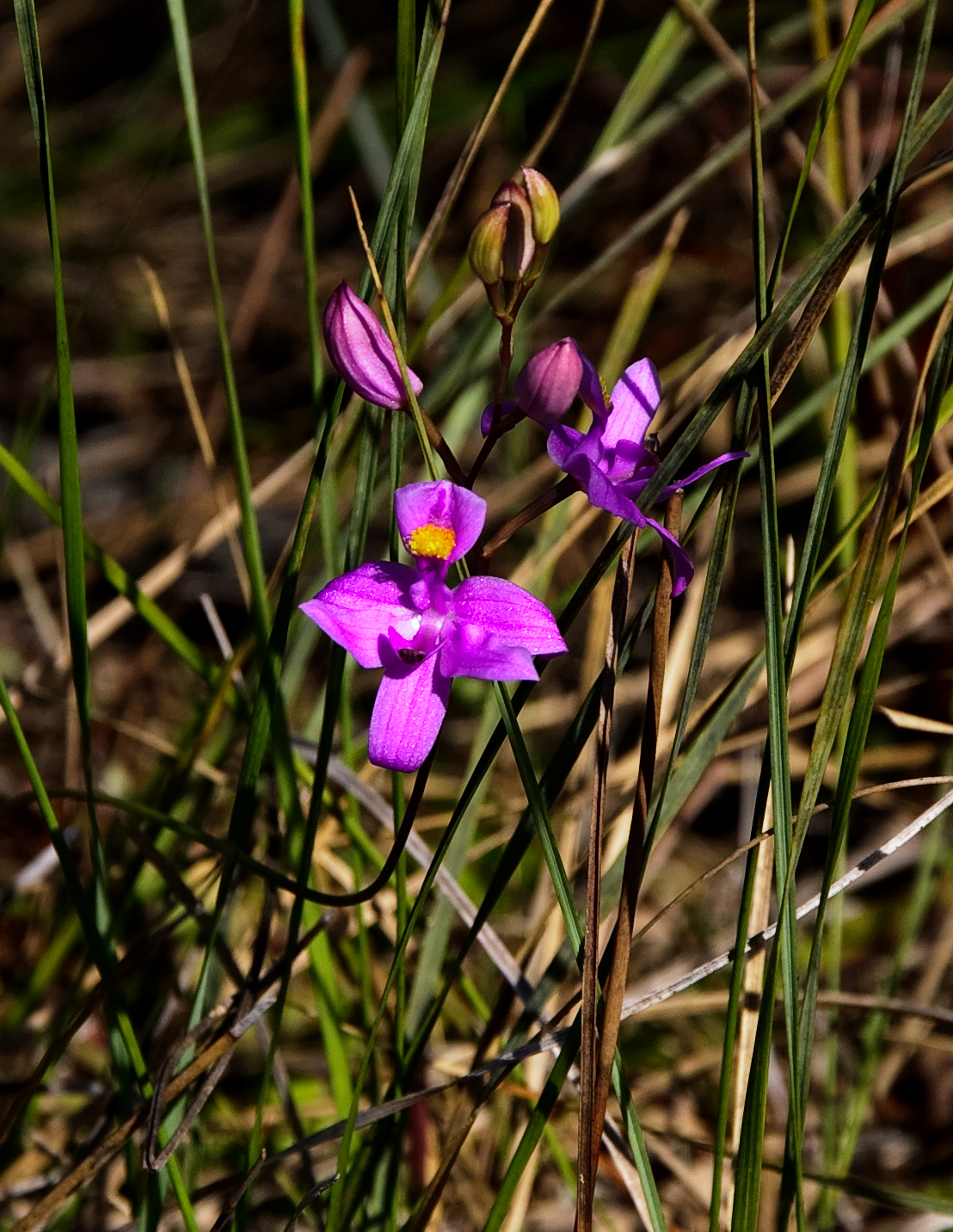
Habitat - The Grass pink is a terrestrial Orchid common to moist Pine flatwoods, Marshes, Bogs and other moist, sunny, sandy sites.
Description - Flowering occurs from March in South Florida to August in the northern sections of the state. Flowers have six petals, the upper most petal is bearded with splotches of yellow and white while the overall color ranges from light pink to magenta and sometimes white. Leaves are linear, basal, clasping the stem and up to 18 inches long. Flowers are produced on an inflorescence that may be up to four feet tall.
Leafless Beaked Ladiestresses - Sacoila lanceolata
Family - Orchidaceae
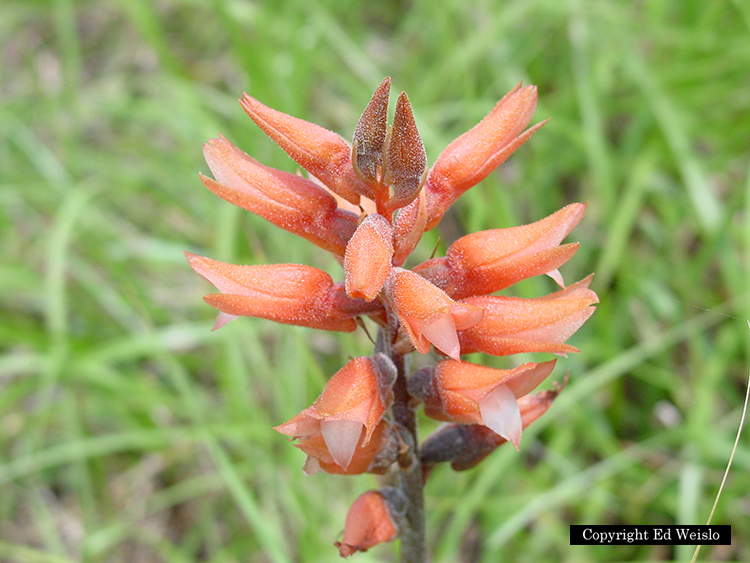
Habitat - Moist to dry open flatwoods, Pastures, Roadsides
Description - Native Florida terrestrial orchid, threatened species. No leaves present at flowering, the basal rosette of six inch, elliptic to lanceolate shaped leaves appear after flowering which may occur only every 2-3 years and after the first spring rains. Leaves are present until cooler winter weather arrives.
Flower - Coral to Orange-Red with pale red to white lip, 9 - 50 flowers are clustered on a 2 foot inflorescence. There is a variety which produces green flowers and a rare yellow or golden form as well.
Marsh Pink - Sabatia grandiflora
Family - Gentianaceae
.jpg)
Habitat - Wet prairie, Wet Pine flatwoods, margins of freshwater marshes.
Description - Native annual herb to 3 feet. Linear to filiform leaves 1 1/2 to nearly 4 inches long.
Flower - Bright pink, 1 1/4 - 2 inches across, usually solitary. Marsh Pinks often form small colonies giving the appearance of a multiple flowered single plant.
Nuttall's Meadowbeauty - Rhexia nuttallii
Family - Melastomataceae
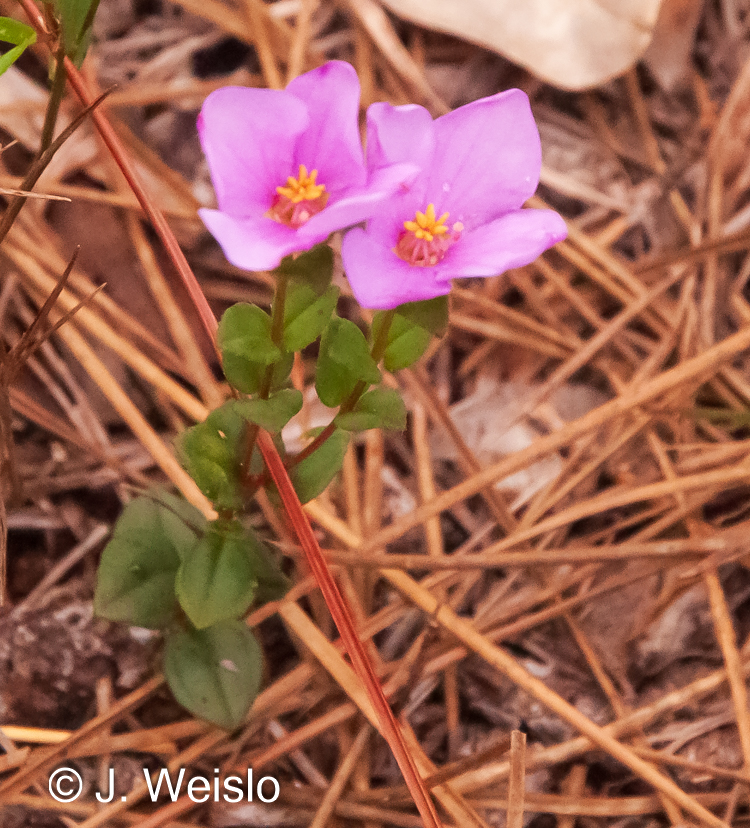
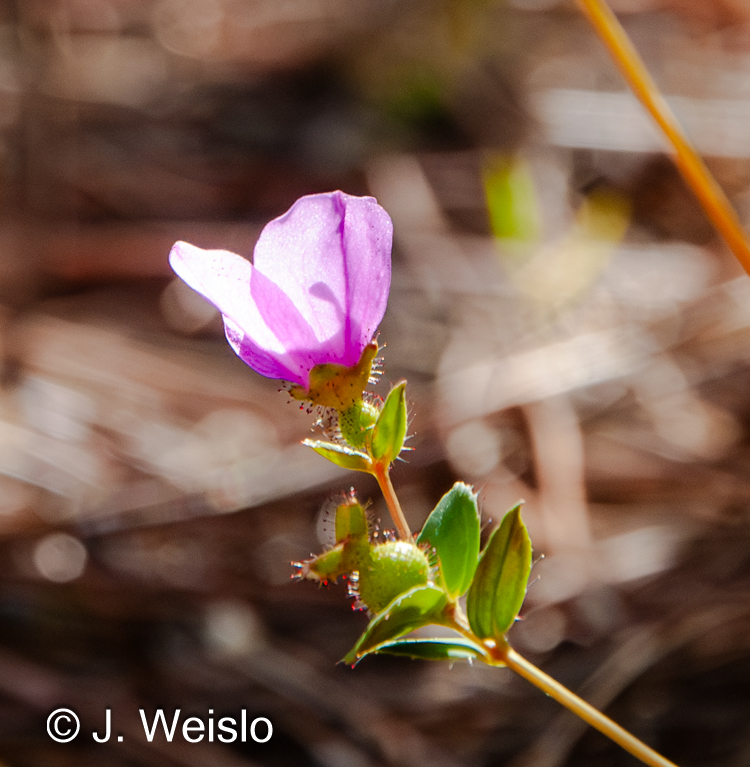
Habitat Nuttall's Meadowbeauty is a Florida native with a strong preference for wet, open landscapes. It can be found growing in pine flatwoods, bogs, wet savannas, and along the margins of ponds and depressions, often in moist, acidic soils under full sun. It is a fairly common sight throughout much of Florida's natural areas.
Plant Characteristics This modest perennial typically reaches about 14 inches in height, with a slender, square stem that may grow upright or sprawl along the ground. Its leaves are oval, arranged in opposite pairs along the stem, and feature three prominent veins with fine hairs along their edges. One of the plant's most distinctive traits is its small, urn-shaped seed capsule (hypanthium), which is noticeably covered in glandular hairs — a reliable detail for telling it apart from similar meadowbeauty species.
Flower The flowers are a delicate rose-pink to soft purple, each bearing four broad, slightly cupped petals that give the bloom an open, airy appearance. Eight short, straight stamens tipped with yellow anthers add a charming contrast at the center. Blooming from spring through summer, the flowers are a favorite of native bees, which buzz-pollinate them by vibrating their bodies to release pollen — a fascinating and specialized interaction between plant and pollinator.
Procession Flower - Polygala incarnata
Family - Polygalaceae
.jpg)
.jpg)
Habitat - Dry Prairie, Flatwoods
Description - Annual herbaceous wildflower native to Florida, growing on well drained, dry sandy soils. 8-24 inches tall, leaves are alternate, linear.
Flower - Dense clusters of purplish-pink flowers on a tall unbranched inflorescence.
Pink Purselane - Portulaca pilosa
Family - Portulacaceae
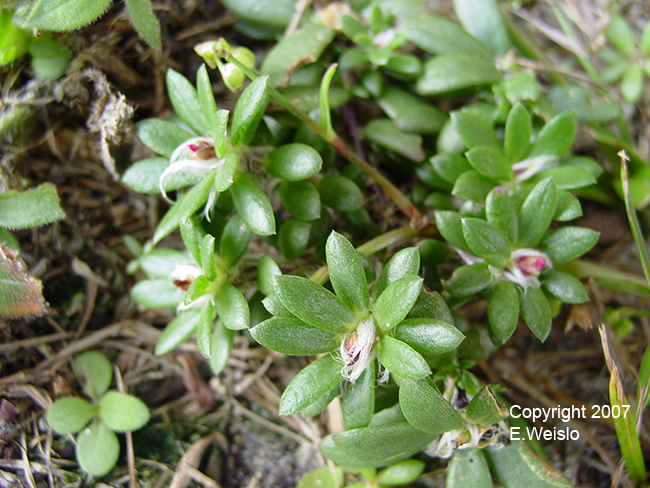
.jpg)
Habitat - Open areas of flatwoods, disturbed sites.
Description - Native wildflower. Annual or Perennial, Forb, Herb, 1 to 6 inches in height, often prostrate in growth habit. Leaves are fleshy, somewhat succulent in appearance. Usually found on sandy, dry soils.
Flower - Pink to purplish, 5/8 inch across, blooms throughout the year in South Florida.
Florida Paintbrush - Carphephorus corymbosus
Family - Asteraceae
.jpg)
%20.jpg)
Habitat - Sandhill, moist to wet flatwoods, scrubby flatwoods.
Description - Florida paintbrush is a native perennial herbaceous wildflower to 3 feet when flowering, basal rosette of spatulate leaves, 1 to 3 inches tall. A butterfly nectar plant.
Flower - Purplish-pink on a tall densely pubescent corymb with sessile leaves.
Scarlet Milkweed - Asclepias curassavica
Family - Apocynaceae
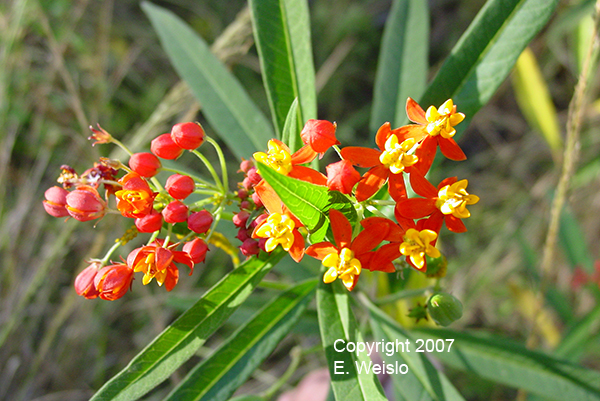
Habitat - Pastureland, ruderal.
Description - Not Native. Perennial sub-shrub, 3 to 4 feet tall. Naturalized in central and south Florida. Often grows with pairs of symmetrically arranged stems, leaves are alternate, narrow oblong to lanceolate, 4 - 8 inches long with entire margins and parallel venation.
Flower - Clusters of brilliant orange and red flowers, nectar and larval host plant for the Monarch butterfly which is immune to its toxins.