Florida Landscape Trees & Shrubs
Popular trees and shrubs for South Florida landscapes, with growing zones and care tips. Page 5 of 6. Click or tap a photo to open it full size.
Red Maple - Acer rubrum
Native
Family - Sapindaceae
Maples were formerly placed in their own family, Aceraceae, which is now part of the soapberry family.
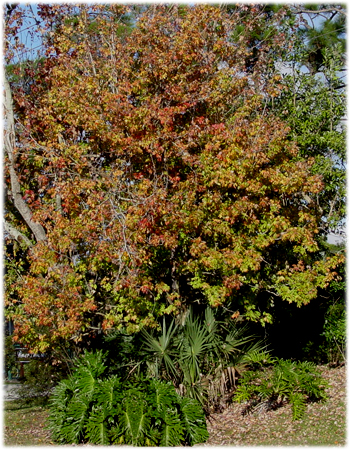
Red Maple is a native deciduous tree to 90 + feet, taller than broad, found statewide and throughout most hardwood swamps, bottomland forests, floodplains of rivers, creeks and lakes. Wet, low-lying and flooded sites, often in conjunction with other hardwood species.
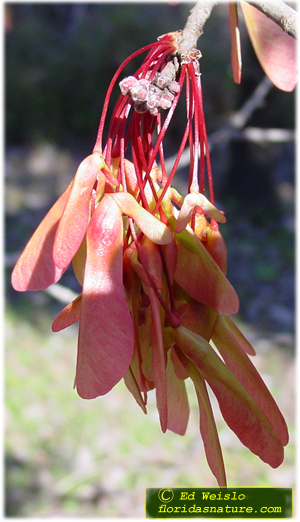
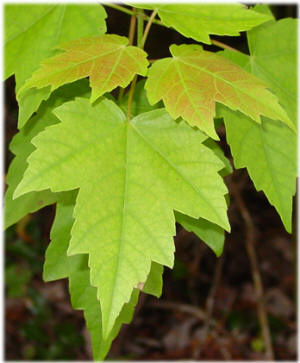
Leaves are opposite with 3-5 lobes, margins serrate, the petioles (leaf stems) & central leaf veins are typically red, as are the fruit, new growth and fall foliage. Small, red flowers in spring, fruit is a red, two winged key (samara), as is typical of maples.
Zones 4 through 10, Red Maple may be used as a shade tree, ornamental, screen or street tree
Culture - Propagation is by seed. Full sun to partial shade. Red Maple is best grown on wet soils in South Florida, or will have to be irrigated. Brown, dead areas within individual leaves are a sign of insufficient water.
Fast growing Red Maple needs slightly acidic to acidic soils with good organic content to thrive & grows poorly on soil low in nutrients. Develops chlorosis on alkaline soils. Red Maple has a striking bright red leaf color in fall & early spring when new growth emerges.
See also the full native-plant entry on Native Trees & Shrubs, page 2.
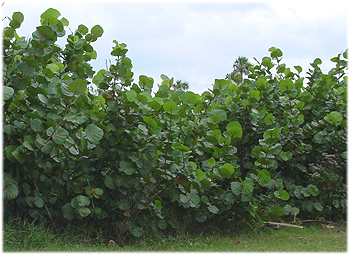
Sea Grape - Coccoloba uvifera
Native
Family - Polygonaceae
Natural Habitat - Dunes, coastal hammocks, coastal strand. Seagrape is a native perennial shrub or tree to a height of 25 - 30 feet with an equal spread, usually with multiple low branching trunks. Leaves are broad, dark green, 8 to 12 inches almost circular in shape with distinctive red veins. New leaf growth in the spring is an attractive shiny bronze color.
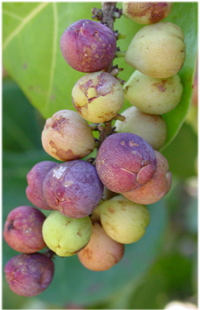
Ivory-white flowers on racemes up to 30 inches long, followed by large clusters of 3/4 inch diameter grape-like berries on female trees. Males produce no fruit. Zones - 10, 11 Specimen tree, fruit tree, screen, buffer zone tree. Seagrape is tolerant of a range of soil types and pH, but grows best in full sun exposure & sandy, well drained soils. Established trees are drought and very salt resistant, making Seagrape an excellent choice for seaside landscapes.
Propagation is by seed or cuttings. Requires initial hand pruning to shape, thereafter is basically maintenance free.
See also the full native-plant entry on Native Trees & Shrubs, page 3.
Rubber Tree - Ficus elastica
Non-native / Exotic
Family - Moraceae
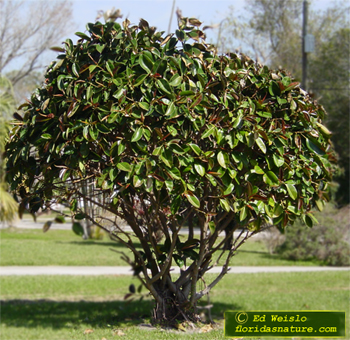
Also known as India Rubber tree or Rubber plant, occasionally used as a landscape tree, the Rubber tree plant is more common as a potted specimen used indoors or on a patio.
A native of India & Indonesia, this tree can exceed 100 feet in its home range, in Florida it is fast growing, reaching about 40 feet tall with a more or less equal spread.
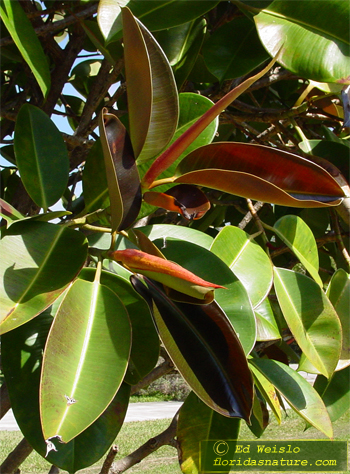
The thick elliptic leaves may be over 12 inches long and are copper colored when new. There are a few cultivars available, one has reddish to copper colored foliage, another has yellow and green variegated leaves.
Zones 10 - 11, full sun to partial shade, if as a container plant indoors Rubber trees should be given as much light as possible, most soils are acceptable, as long as it is well drained. Water thoroughly & allow to dry out well between watering, the natural habit of growth is with multiple trunks but they can be pruned when young to train as a single trunked tree. No serious pests, subject to damage in high winds. Excellent drought tolerance, medium salt air tolerance.
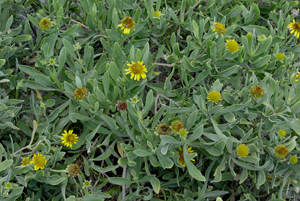
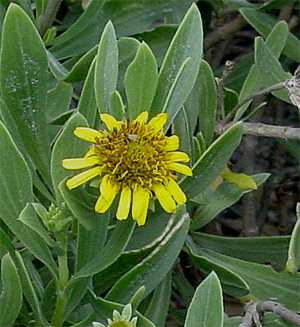
Bushy Seaside Tansy, Sea Oxeye - Borrichia frutescens
Native
Family - Asteraceae
Also known as sea oxeye. The family was formerly called Compositae.
Natural Habitat - Salt marshes, mangrove swamps, brackish & saltwater river shorelines, low areas back of dunes.
Native perennial emergent shrub, 1-4 feet high with an equal spread, Seaside tansy leaves are a grey-green color, thick, fleshy, simple, obovate to spatulate, 2-4 inches long with acutely pointed tips. Flowers are produced year round & are yellow with brownish centers
Zones - 10, 11 Ground cover, group plantings, border shrub, attracts butterflies. Bushy seaside tansy is propagated by seed or cuttings this plant spreads naturally via rhizomes. Full sun, salt tolerant, low to medium drought tolerance. Sandy to organic soils, soil pH acidic to alkaline
See also the full native-plant entry on Yellow Wildflowers.
Dwarf Schefflera - Heptapleurum arboricola
Non-native / Exotic
Family - Araliaceae
Formerly Schefflera arboricola, the name it is still sold under.
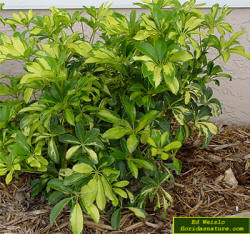
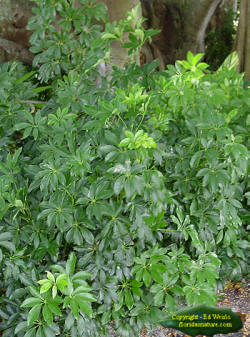
Dwarf Schefflera, also called Arboricola grows well in zones 9 - 11. The palmate compound leaves are dark green and of medium texture with the exception of the variegated form shown, which has yellow throughout.
Very drought resistant, Dwarf schefflera prefers sandy soils and likes to be kept on the dry side rather than moist.
Easily pruned to size and shape this versatile plant can be grown in full sun to dense shade and may be used for hedges, a specimen plant or as a potted house plant. Dwarf schefflera can attain heights around 10 feet. Flowers are green, inconspicuous and are followed by orange, fleshy berries in the winter.
Toxic plant: Dwarf schefflera contains calcium oxalate crystals that irritate the mouth and throat if chewed, causing drooling and vomiting; pets are the most common victims. If a person chews or swallows it, call Poison Control at 1-800-222-1222 or seek emergency care. For a pet, call your veterinarian or the ASPCA Animal Poison Control Center at (888) 426-4435 (a fee may apply).
Silver Trumpet Tree - Tabebuia aurea
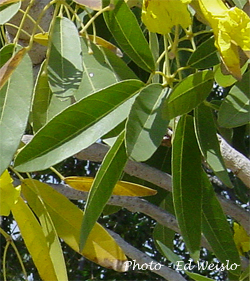
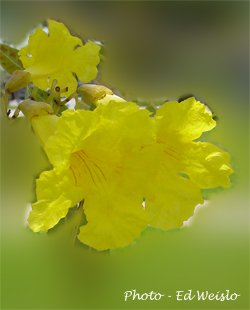
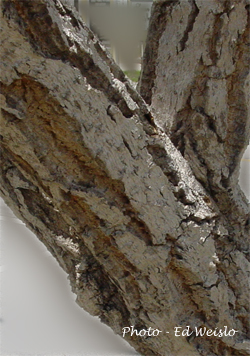
Non-native / Exotic
Family - Bignoniaceae
Formerly listed as Tabebuia caraiba.
Description - The Silver Trumpet tree is called by several common names including - Yellow trumpet, Caribbean trumpet, Golden trumpet, Ipê, Poui. There is also a pink-flowered relative, Tabebuia heterophylla, or pink trumpet.
Trumpet trees generally drop all or most of their leaves just prior to blooming, with profuse terminal clusters of 2-3 inch yellow, trumpet shaped flowers in spring and sporadically throughout the growing season.
The bark is thick, deeply furrowed and corky, which when combined with trunks that are often contorted give the impression of an old windswept tree.
Zones - 10, 11 Best in full sun, Trumpet trees can take some partial shade, are fairly tolerant to drought, salt air and a wide range of soil types and pH. Landscape Use - Street tree, specimen, accent tree or large container.
Screw Pine - Pandanus utilis
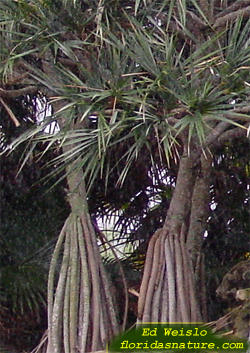
Non-native / Exotic
Family - Pandanaceae
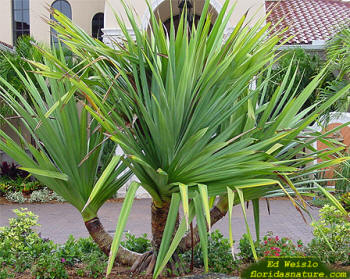
The screw pine is a monocot, like palms, rather than a true tree. Reaching heights of 25-30 feet this "tree" can have an equal or greater spread.
With prop roots reminiscent of Red mangrove trees, the Screw pine produces stout branches with leaves arranged in spirals at the branch ends. Leaves are strap-like, up to 3' long with small spines along the edges.
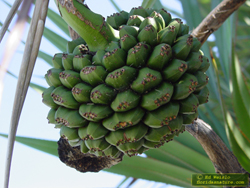
The Screw pine is a tropical tree in appearance as well as by nature & female plants produce a large round or cylindrical fruit, eight inches or more in diameter hanging by a stout stem.
Culture - Small plants will take some shade, fruiting requires full sun. Not too picky about soil but it should be well drained. Screw pine requires a median amount of moisture until established.
Screw pine grows in USDA zones 10-11, is drought tolerant and resistant to salt air back from the dune and is commonly used as a specimen plant or grown in a container.
There are several varieties of Screw pine available including one with variegated leaves.
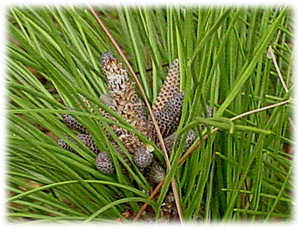
Slash Pine - Pinus elliottii
Native
Family - Pinaceae
Natural Habitat - Moist to dry Flatwoods, Scrubby flatwoods, Sandhill, margins of wetlands.
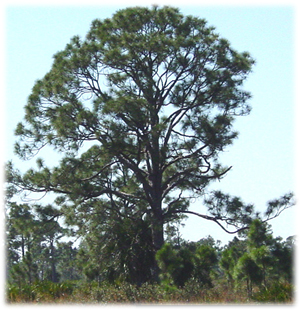
Slash pine is a fast growing large tree, reaching 75 - 100 feet tall with a 3 to 4 ft. diameter trunk.
Pine cones are 3 - 6 inches in length to 3 inches in diameter, seeds are a favorite food of squirrels and turkey.
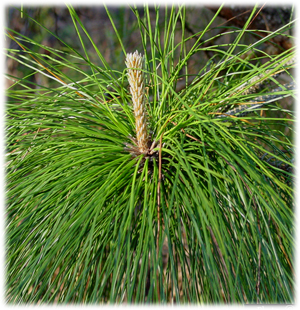
Bark is grey-brown & deeply furrowed, with scaly orange plates. Needles are 8 -12 inches long, 2 or occasionally 3 per fascicle. Crown is open, irregular, oval to pyramidal with ascending branches.
Slash pine is a good tree for creating a dappled shade for under plantings of azaleas or other plants which love lightly shaded conditions. Excellent effect when planted in scattered groups of three or more.
Although it's occasionally used for screen plantings it's not a great choice for this as it loses its lower branches as the tree gets larger.
Zones 7 - 11, Propagated from seed, Slash pine grows best in full sun or partial shade on well to poorly drained, moist, sandy acidic soils and will tolerate moderate seasonal flooding. Will tolerate slightly alkaline soil pH, but develops chlorosis on strongly alkaline soil. Slash pine has a moderate tolerance to drought and salt air.
See also the full native-plant entry on Native Trees & Shrubs, page 1.
Sea Lavender, Sea Rosemary - Heliotropium gnaphalodes
Native
Family - Boraginaceae
Formerly Argusia gnaphalodes (also Tournefortia gnaphalodes).
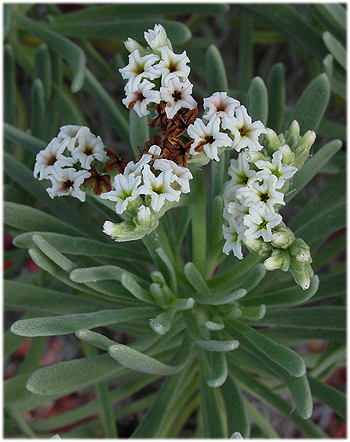
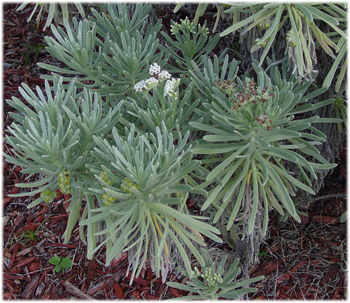
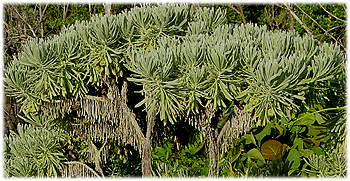
Sea Lavender (also known as Sea Rosemary) is an endangered Florida native perennial shrub to 2 - 5 feet tall with an equal or greater spread and a rounded crown.
Leaves are pubescent with a fleshy, succulent appearance & are linear to slightly spatulate, greenish-gray in color.
Sea Lavender flowers year round, the flowers emerge on a one sided spike & are white with a green throat, changing to a pinkish lavender color as they age. Fruit is a single seeded berry or drupe with a buoyant, corky outer layer which allows for widespread dispersal by water.
Zones - 10,11 Sea Lavender can be used as a ground cover, border plant or in groupings. Propagation is by seed or cuttings. Full sun on fast draining, sandy, acidic to alkaline soils.
Natural Habitat - Coastal scrub, Dunes, Sea Lavender is salt and drought tolerant, adapted to the very nutrient poor, dry sandy soils of the coastal strand. The most common problem encountered with inland cultivation is root rot from too much water.
See also the full native-plant entry on Native Trees & Shrubs, page 10.
Sand Live Oak - Quercus geminata
Native
Family - Fagaceae
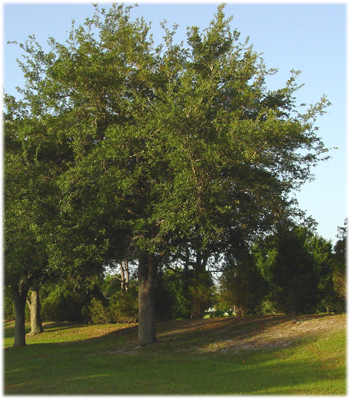
Although the Sand Live Oak is capable of a height of 90 plus feet it's more often under 40 feet. In dry scrub habitat it often grows in shrub-like proportions of less than 15 feet, sometimes growing in dense thickets.
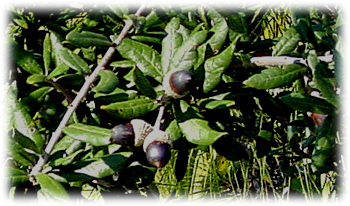
Sand Live Oak resembles Live Oak, Quercus virginiana, in several respects. The most notable difference is that Sand Live oak leaves are revolute, that is the margins are rolled under and leaf veins are markedly impressed into the surface of the leaf.
Leaves are alternate, leathery, revolute, 1-4 inches long, margins entire. Bark is grey, thick and furrowed, the acorns are produced in pairs and groups of three, and are slightly elongated.
Landscape Use - Excellent accent or specimen tree for dry sandy sites, or as an alternative to the Live Oak tree in smaller scale landscapes.
Zones 7-10, Sand live oak likes full sun, well drained sandy soils with little or no organic content. Moderate salt tolerance, should be protected from direct salt spray, high drought tolerance once established. Growth rate varies in relation to the amount of available moisture.
See also the full native-plant entry on Native Trees & Shrubs, page 1.